
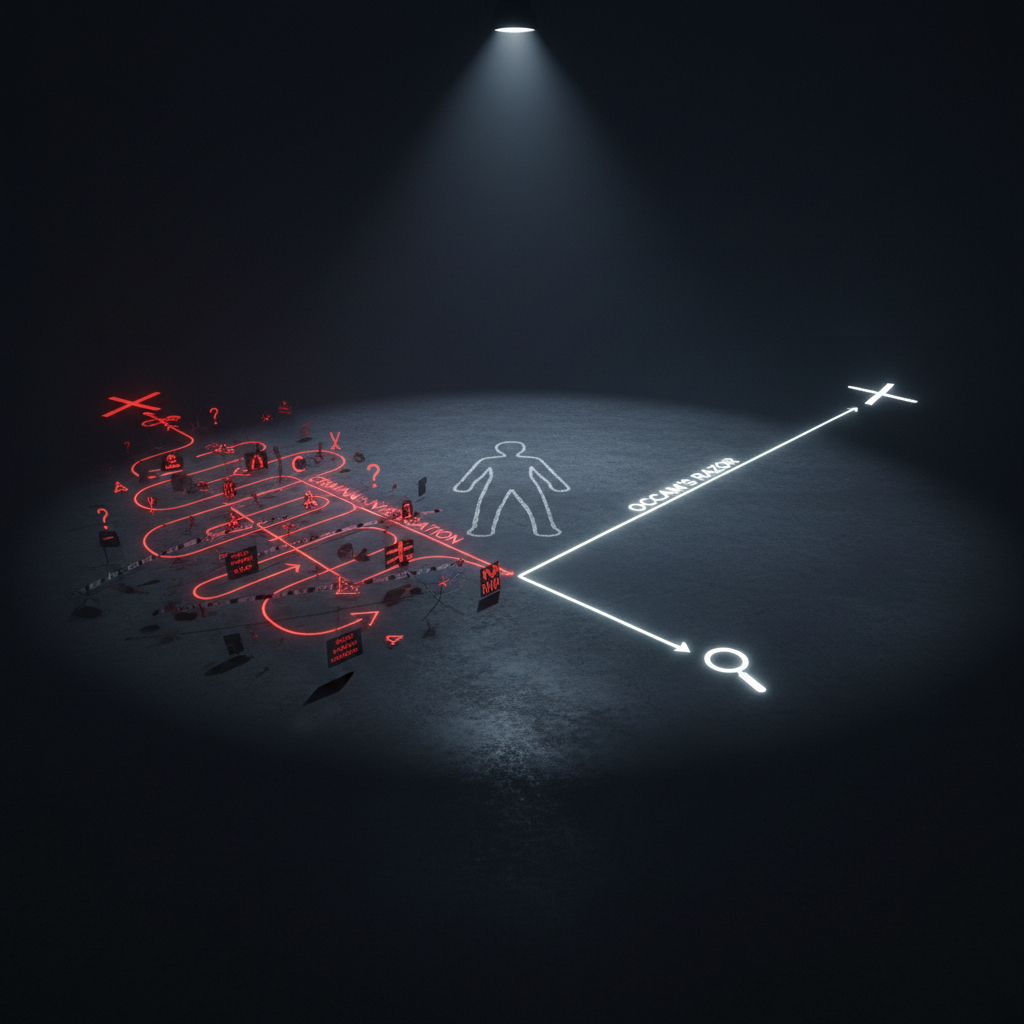
The Simplest Explanation: How Occam's Razor Solves Crimes Investigators Overcomplicate
Time and again, investigators chase elaborate theories while the simplest answer sits in plain sight. A look at famous cases where Occam's Razor — the principle that the simplest explanation is usually correct — was ignored with disastrous consequences.
The 14th-century friar William of Ockham never investigated a murder. But his philosophical principle — that among competing explanations, the one requiring the fewest assumptions should be preferred — has become one of the most powerful tools in criminal investigation. And one of the most routinely ignored.
THE PRINCIPLE: Occam's Razor does not say the simplest explanation is always right. It says, all else being equal, unnecessary complexity should be shaved away. In criminal investigation, this translates to a practical rule: before building an elaborate theory, exhaust the obvious ones.
THE RICHARD JEWEL CASE: In 1996, Richard Jewel discovered a suspicious backpack at the Atlanta Olympics and helped evacuate hundreds of people before a bomb exploded. He was a hero. Within days, he was the FBI's primary suspect.
The theory: Jewel had planted the bomb himself to become a hero and advance his career. It was elaborate, psychologically complex, and required multiple assumptions about his motives. The FBI leaked it to the press. Jewel was tried in the court of public opinion for months.
The simpler answer — that a man who spotted and reported a bomb had simply spotted and reported a bomb — was ignored. The real bomber, Eric Rudolph, wasn't identified until 1998. Jewel was officially cleared in October 1996, but his reputation never fully recovered.
THE PATTERN: Confirmation bias leads investigators to build complexity around a chosen suspect rather than following the simplest evidentiary path. The more invested they become in a theory, the more elaborate it grows — and the harder it becomes to abandon.
THE CORRECTIVE: Modern investigative protocols at agencies including the FBI and Scotland Yard now formally include "alternative hypothesis testing" — a structured requirement to consider simpler explanations before committing to complex theories. It is Occam's Razor, institutionalized.
THE LESSON: When a case seems to require an elaborate explanation, ask: what is the simplest interpretation of the available evidence? More often than not, that is the answer.
Tell us your thoughts in the comments below.
Please like and subscribe for more investigations from The Evidence Log.
Comments (0)
No comments yet. Be the first to share your thoughts.
Follow Us
© 2025 The Evidence Log. All rights reserved.
Sponsored by www.MilitaryDiscount.net
Website Designed By CharmCityInteractive.com