
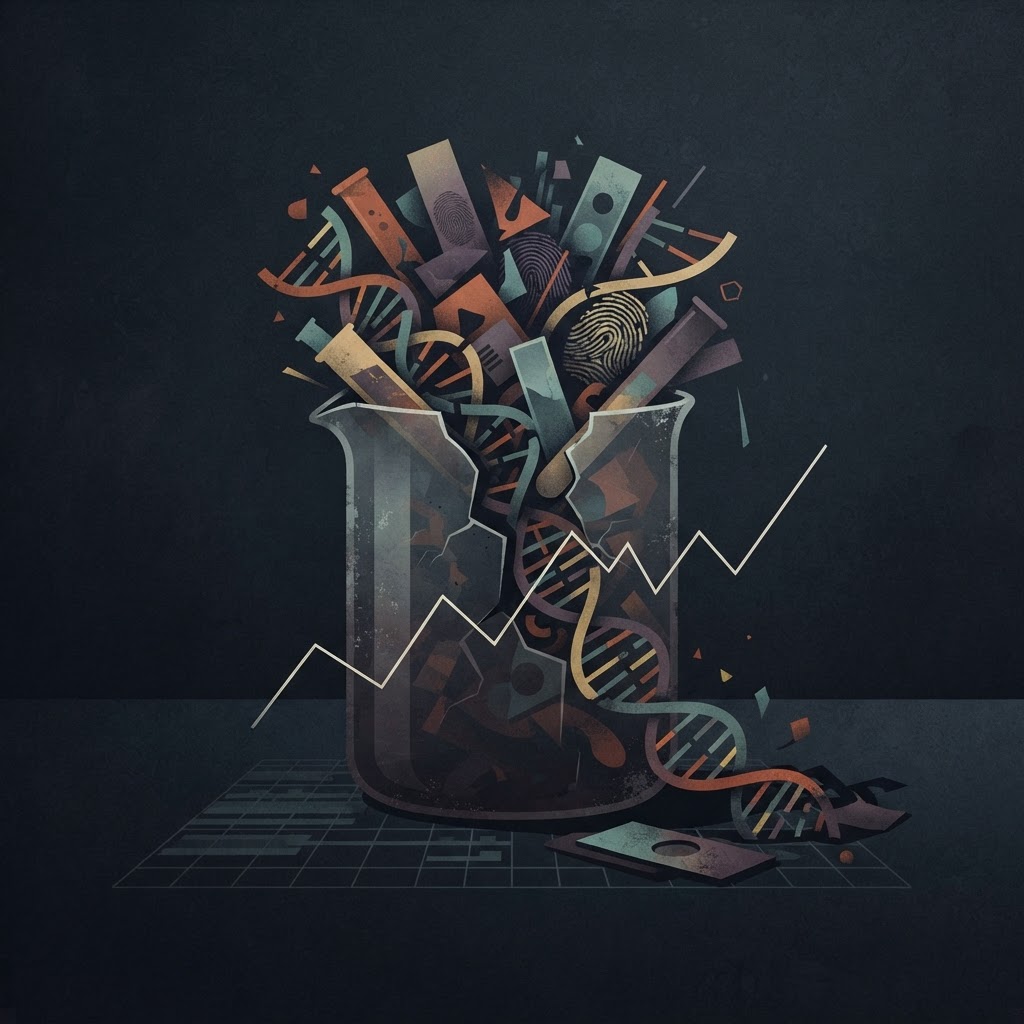
The Paper Trail of Pseudoscience: How Junk Science Infiltrates Courtrooms, Legislatures, and the Public Mind
From debunked hair analysis to fabricated pharmaceutical studies, junk science doesn't just pollute academic journals — it sends people to death row and shapes national policy. Here's how it works, and why it persists.
The Anatomy of a Scientific Lie
Science, at its best, is a self-correcting system. Hypotheses are tested, findings are replicated, and errors are — eventually — exposed. But that word eventually carries enormous weight. In the gap between the publication of a flawed study and its retraction, careers are built, policies are written, and in some cases, people are convicted of crimes they did not commit.
Junk science is not simply bad science. It is science-shaped content: research or testimony that mimics the language, structure, and authority of legitimate inquiry while lacking its core foundations — rigorous methodology, sufficient evidence, and theoretical plausibility. It is, in many ways, a more dangerous phenomenon than outright fraud, because it is harder to identify and easier to defend.
Understanding junk science requires examining not just individual cases of misconduct, but the systemic and psychological conditions that allow it to take root.
The Courtroom as a Laboratory for Doubt
Perhaps nowhere is the damage of junk science more concrete than in the criminal justice system. According to data compiled by the Innocence Project and related organizations, 32% of death row exonerations have involved at least one form of junk science. These are not abstract statistical errors. They are people who spent years — sometimes decades — on death row based on testimony that the broader scientific community had either never validated or had actively repudiated.
The forensic sciences have been a particularly fertile ground for this problem. For decades, techniques such as bite mark comparison, bloodstain-pattern analysis, and microscopic hair comparison were presented to juries as reliable, expert-backed methods of identifying perpetrators. They were delivered with confidence by credentialed witnesses, illustrated with diagrams, and accepted without meaningful challenge.
The reality was starkly different. A 2015 review of FBI casework found that examiners had provided scientifically invalid testimony in over 95% of cases involving microscopic hair analysis. That figure — 95% — is not a margin of error. It is a systemic failure embedded in hundreds of trials. The technique had never been subjected to the kind of rigorous validation studies required to establish error rates or foundational reliability. Yet it was used, repeatedly and confidently, to help secure convictions.
The case of 911 call analysis illustrates how newer, equally unvalidated methods continue to enter courtrooms. Proponents of this technique claim they can detect deception in the speech patterns of emergency callers — the pacing of words, the emotional register, the specific language chosen under duress. It sounds plausible. It exploits intuitions many people already hold about how guilty people behave. And it has been used in real prosecutions, including the conviction of Jessica Logan, despite the absence of any rigorous peer-reviewed evidence establishing its scientific validity.
This is the essential pattern: a technique is developed, given a name that sounds technical, and introduced into legal proceedings before the scientific community has had the opportunity — or, in some cases, the inclination — to evaluate it properly.
The Reproducibility Crisis and Its Consequences
The problem of junk science cannot be separated from a broader crisis in scientific publishing. A 2016 Nature survey found that more than 70% of researchers had failed to reproduce another scientist's experiments. More than half had failed to reproduce their own. This is not a fringe concern raised by skeptics — it was acknowledged by working scientists across disciplines, from psychology to pharmacology to oncology.
The Retraction Watch database, which tracks withdrawn scientific publications, now contains over 63,000 retracted papers, with a record 10,000+ retractions occurring in 2023 alone. Some of these retractions reflect honest error. Others reflect something more troubling: fabricated data, undisclosed conflicts of interest, and studies designed to reach predetermined conclusions.
The structural incentives of academic publishing have contributed to this environment. The so-called publish or perish culture rewards volume and novelty over replication and rigor. Journals have historically been more likely to publish positive results than negative ones, creating a literature that systematically overstates the strength of evidence. When replication studies fail to confirm original findings, they often go unpublished — leaving the flawed original to accumulate citations and influence.
In this ecosystem, a single well-placed paper can do extraordinary damage. Researchers examining litigation around abortion access identified what they described as fatally flawed peer-reviewed studies being used in court cases to argue against the safety of mifepristone. The studies had passed through peer review. They carried the formal markers of scientific legitimacy. And they were being introduced as evidence in proceedings that could affect access to a medication used by hundreds of thousands of people annually. The broader scientific community mobilized to challenge and retract the studies — but the legal proceedings did not pause to wait for that process to conclude.
The Psychology of Plausibility
Why does junk science work? Part of the answer lies in the sociology of expertise — the deference that laypeople, including jurors and legislators, extend to those who present themselves as scientific authorities. But psychological research points to something deeper.
Junk science tends to succeed when it aligns with pre-existing intuitions. The fear of contagion, the desire for simple explanations for complex events, the sense that guilt must be visible in behavior — these are not irrational impulses. They are cognitive tendencies that evolved for good reasons and that remain deeply embedded in human judgment. Pseudoscience, as researchers have documented, frequently gains traction precisely because it exploits these intuitions rather than challenging them.
A juror who already suspects a defendant is more likely to find the testimony of a hair analyst or a 911 call expert credible — not because they have evaluated the underlying methodology, but because the testimony confirms what they already feel. The scientific trappings provide justification for a conclusion that intuition had already supplied.
This dynamic is not limited to courtrooms. The tobacco industry's decades-long campaign against research linking smoking to lung cancer relied on the same mechanism. Rather than producing credible counter-evidence, industry-funded researchers and lobbyists focused on identifying minor methodological flaws in legitimate studies and amplifying them into generalized uncertainty. The goal was not to disprove the science, but to make the public feel that the science was unsettled — that reasonable people could disagree, and that therefore no action was warranted.
This strategy — the deliberate exaggeration of scientific uncertainty to manufacture doubt — has since been replicated across industries and policy domains. It is perhaps the most sophisticated application of junk science, because it requires no fabricated data. It requires only the selective and strategic misrepresentation of legitimate uncertainty.
The Gap Between Retraction and Reality
One of the most underappreciated features of junk science is its persistence. Studies get retracted. Techniques get debunked. Expert witnesses get discredited. But the convictions secured on the basis of their testimony do not automatically unravel. The legal system's mechanisms for revisiting past verdicts are slow, resource-intensive, and weighted against defendants.
Similarly, in public discourse, retracted studies continue to be cited. Debunked forensic techniques continue to be referenced in training materials. The self-correcting mechanisms of science operate on a timescale that is simply not compatible with the speed at which courtrooms deliver verdicts or legislatures pass laws.
This is not an argument for scientific nihilism — for treating all research as equally unreliable. It is, rather, an argument for structural reform: of how forensic techniques are validated before being admitted as evidence, of how peer review handles studies with significant legal or policy implications, and of how the legal system adjudicates claims that rest on contested science.
The evidence behind junk science is, ultimately, evidence of a systems problem. Individual fraudsters and bad-faith actors exist, but they operate within and are enabled by institutional structures that have not yet caught up with the consequences of getting the science wrong. Until those structures change, the gap between what courts accept as science and what science actually supports will remain — and people will continue to pay the price for it.
Comments (0)
No comments yet. Be the first to share your thoughts.
Follow Us
© 2025 The Evidence Log. All rights reserved.
Sponsored by www.MilitaryDiscount.net
Website Designed By CharmCityInteractive.com