
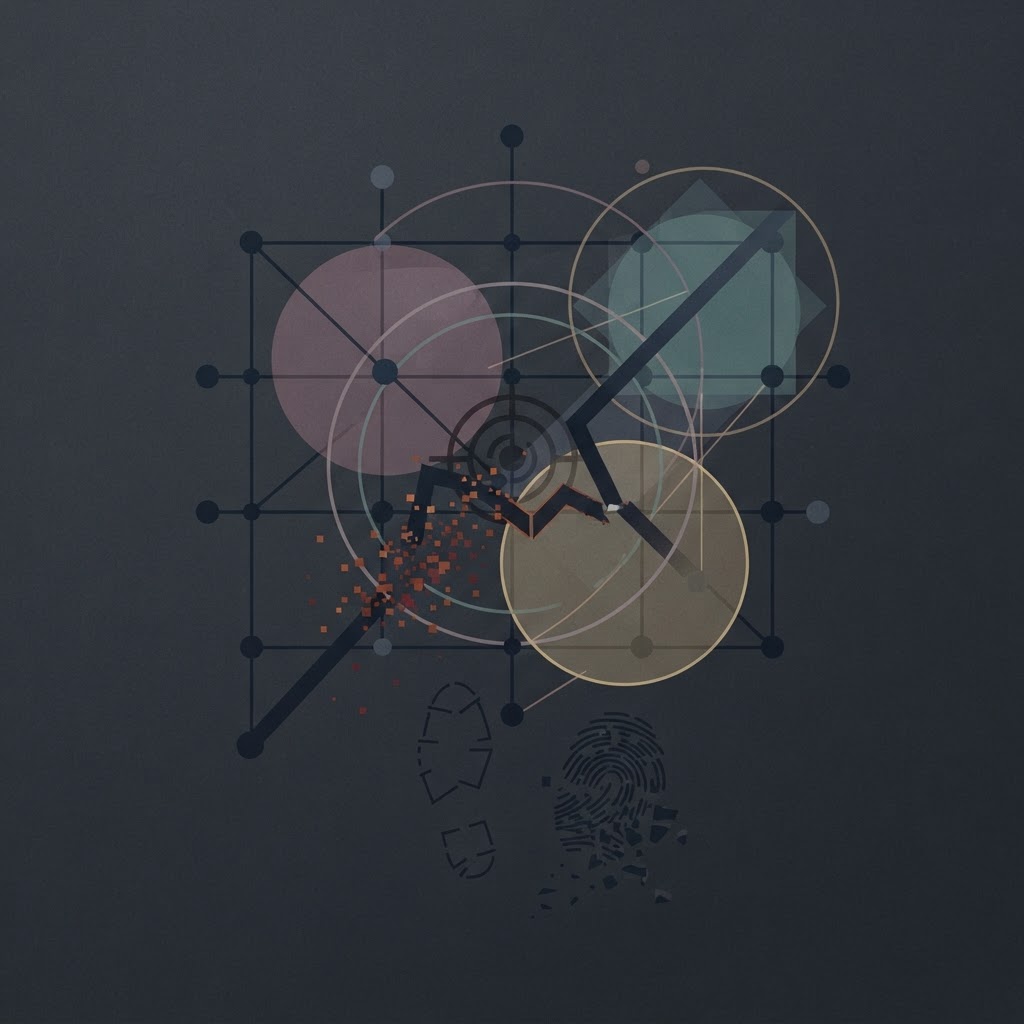
The Bias Cascade: How Forensic Science Fails Long Before It Reaches the Courtroom
Forensic evidence is widely regarded as the gold standard of criminal proof — but a growing body of research reveals that the path from crime scene to conviction is riddled with cognitive traps, institutional pressures, and unvalidated methods that together manufacture certainty where none exists.
The Illusion of Objectivity
There is a particular kind of authority that forensic evidence carries in a courtroom. A fingerprint match, a fiber comparison, a bite mark overlay — these are presented as the language of science, cold and impartial, immune to the messy subjectivity of eyewitness testimony or coerced confessions. Jurors believe them. Judges defer to them. And yet, the misapplication of forensic science is now documented as the second most common contributing factor to wrongful convictions in the United States.
That statistic alone should give us pause. But the more unsettling revelation, drawn from a systematic study of 732 wrongful convictions linked to forensic evidence, is that most of these errors were not the result of scientific misidentification in the technical sense. They were the product of miscommunication, organizational deficiencies, and prosecutorial misconduct. In other words, the science was not simply wrong — the systems surrounding it were broken in ways that made errors not just possible, but nearly inevitable.
The Bias Snowball Starts Small
To understand how forensic evidence fails, you have to understand where the failure actually begins. Research into forensic psychology has identified two related phenomena: the bias snowball and the bias cascade. These describe how small, early interpretive errors — often introduced by contextual information provided to an analyst at the outset of an investigation — can compound across every subsequent stage of analysis, hardening into conclusions that are nearly impossible to dislodge once they enter the legal record.
Consider the mechanics: a forensic analyst is told, before examining evidence, that a suspect has a prior criminal record and was found near the scene. This information is not scientifically relevant to, say, a fingerprint comparison. But it is psychologically potent. Confirmation bias — the well-documented cognitive tendency to seek and favor information that confirms pre-existing beliefs — can subtly warp the analyst's interpretation. A partial print that might otherwise be deemed inconclusive suddenly resolves, in the analyst's mind, into a match.
The Brandon Mayfield case is among the most instructive illustrations of this dynamic. In 2004, following the Madrid train bombings, the FBI's forensic laboratory identified Mayfield, an Oregon attorney and Muslim convert, as a source of a fingerprint found on a bag of detonators. Multiple experienced examiners independently verified the match. Mayfield was arrested. He was innocent. Spanish authorities later identified the actual source. Post-incident reviews found that the analysts had been influenced by contextual knowledge about Mayfield — his religion, his legal work representing a convicted terrorist in a custody dispute — and that this context had colored their reading of ambiguous ridge detail. The science did not fail in isolation. The science failed inside a human mind operating under institutional pressure.
Disciplines Built on Uncertain Ground
The Mayfield case involved fingerprint analysis, a discipline with a longer evidentiary track record than most. But what happens when the underlying forensic methodology itself lacks rigorous scientific validation?
A significant body of research has now catalogued forensic disciplines that have been historically accepted in courts despite having weak or absent scientific foundations. Bite mark analysis, hair microscopy comparison, and certain arson investigation techniques are among the most scrutinized. For decades, analysts testified with confidence about the uniqueness of bite marks or the distinctive characteristics of hair samples. Convictions were secured. Sentences were served.
The Innocence Project's review of the first 225 DNA exoneration cases in the United States found that unvalidated or improper forensic science played a contributing role in more than 50% of those wrongful convictions. When DNA evidence — a methodology with genuine statistical grounding — was finally applied, it did not just exonerate individuals. It retroactively exposed the fragility of the disciplines that had helped convict them.
This is not simply a historical problem. Many of these methods remain in active use. Courts continue to admit testimony built on frameworks that have never been subjected to the kind of rigorous, dynamic, peer-reviewed validation that characterizes fields like molecular biology or epidemiology. The legal system's standard for admissibility has, in many jurisdictions, lagged significantly behind the scientific community's own evolving understanding of what constitutes reliable methodology.
The Expert Witness Problem
Adversarial Allegiance and the Numbers Behind It
Even where a forensic method has some scientific validity, the courtroom introduces a second layer of distortion: the expert witness system itself. Under an adversarial legal model, both prosecution and defense retain their own experts, each of whom testifies in support of the side that hired them. Research has consistently found that prosecution-retained experts are statistically more likely to classify defendants as high-risk or dangerous compared to independent or defense-retained experts. This phenomenon, known as adversarial allegiance, suggests that expert conclusions are shaped — consciously or not — by the interests of the retaining party.
The data on trial testimony is particularly stark. In a review of 137 DNA exoneration cases, 60% of the forensic experts involved had provided invalid testimony at trial. Invalid testimony includes overstating the statistical significance of a match, claiming a method has a lower error rate than evidence supports, or asserting scientific certainty in areas where the field acknowledges meaningful uncertainty. These are not simply honest mistakes made under the pressure of cross-examination. Many represent patterns of testimony that served the prosecution's narrative at the direct expense of scientific accuracy.
A 19th-Century Warning
The Alfred Dreyfus affair, though predating modern forensic science, remains a remarkably prescient case study in how institutional bias can corrupt evidentiary interpretation. Dreyfus, a French Army officer wrongfully convicted of treason in 1894, was condemned in part on the basis of handwriting analysis offered by experts whose conclusions were shaped by anti-Semitic prejudice and military pressure to find a culpable party. When subsequent independent analysis challenged those findings, the original experts doubled down rather than recalibrate. The bias cascade had already calcified into institutional certainty.
The structural parallels to contemporary forensic failures are not incidental. Where an institution — whether a 19th-century military tribunal or a modern crime laboratory embedded within a police department — has an interest in a particular outcome, the independence of its analytical processes is structurally compromised.
The Systemic Architecture of Error
What the data ultimately reveals is not a story of individual bad actors corrupting an otherwise reliable system. It is a story of a system whose architecture makes error not just possible, but structurally predictable. Forensic analysts frequently work within law enforcement organizations, creating organizational cultures in which confirmation of investigative hypotheses is implicitly rewarded. Contextual information flows freely to analysts who should, under rigorous blind-testing protocols, be shielded from it. Disciplines with no validated error-rate data are treated in courtrooms as though they carry the same evidentiary weight as nuclear chemistry.
The remedies that researchers and reform advocates consistently identify — blind verification protocols, mandatory disclosure of error rates, independent accreditation of forensic laboratories, and more rigorous judicial gatekeeping of novel or unvalidated methods — are neither radical nor particularly expensive. What they require is an institutional willingness to subordinate the drive for conviction to the demand for accuracy.
What the Evidence Says About Evidence
Forensic science, at its methodological core, is a powerful tool. DNA profiling, toxicological analysis, and digital forensics have genuine scientific grounding and have both convicted the guilty and exonerated the innocent with demonstrable accuracy. The problem is not that forensic science exists. The problem is that its credibility — earned by its strongest disciplines — has been extended, uncritically, to methods that have never earned it. And because juries cannot easily distinguish between a methodology with a validated error rate of 1 in 10 million and one with no validated error rate at all, the courtroom presentation of both carries roughly equivalent persuasive weight.
The evidence behind flawed evidence, in the end, points to a system that has confused the appearance of scientific authority with its substance. Correcting that confusion is not merely a matter of legal reform. It is a matter of basic empirical honesty about what we actually know, and how reliably we know it, when a person's liberty is on the line.
Comments (0)
No comments yet. Be the first to share your thoughts.
Follow Us
© 2025 The Evidence Log. All rights reserved.
Sponsored by www.MilitaryDiscount.net
Website Designed By CharmCityInteractive.com