
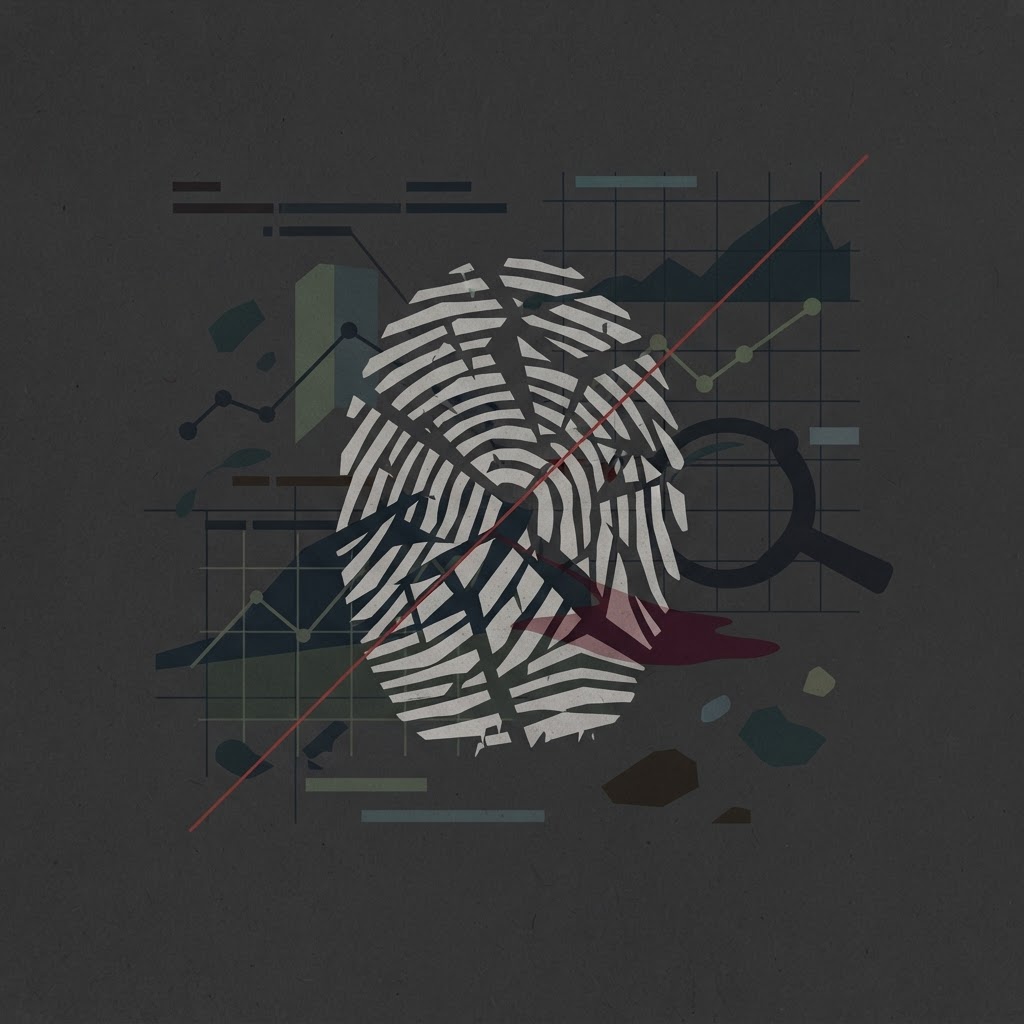
The Certainty Illusion: How Flawed Forensic Science Has Shaped Wrongful Convictions
Decades of courtroom testimony presented forensic evidence as near-infallible truth — but landmark scientific reviews, mass exonerations, and exposed laboratory fraud tell a vastly different story about the evidence behind the evidence.
The Certainty Illusion: How Flawed Forensic Science Has Shaped Wrongful Convictions
In American courtrooms, forensic evidence carries a particular kind of weight. When an expert takes the stand and declares a fingerprint match, a hair consistent with the suspect, or a burn pattern consistent with arson, juries tend to listen — and believe. For decades, that belief was treated as reasonable. The science, after all, was the science. Objective. Reproducible. Certain.
It was not.
A growing body of landmark reports, DNA exoneration data, and exposed laboratory misconduct has dismantled the myth of forensic infallibility, revealing a discipline that was — and in many areas, still is — built on methodology developed inside law enforcement agencies rather than peer-reviewed academic laboratories. The consequences have been measured not in abstractions, but in decades of wrongful imprisonment and, in at least one documented case, an irreversible execution.
A System Built on Assumption, Not Validation
The fracture point in forensic science is not difficult to locate. In 2009, the National Academy of Sciences released a sweeping assessment of forensic disciplines that sent tremors through the legal and scientific communities. Its central finding was unambiguous: other than DNA analysis, no forensic method has been rigorously shown to consistently and reliably demonstrate a connection between evidence and a specific individual.
That single sentence indicted an entire ecosystem of courtroom science — fingerprinting, bite mark analysis, hair microscopy, ballistics, tool mark comparison, and arson investigation — disciplines that had spent decades presenting themselves to juries with an authority they had never scientifically earned. The 2016 President's Council of Advisors on Science and Technology (PCAST) report reinforced this conclusion and went further, specifically labeling bite mark analysis as having no scientific validity and failing to meet foundational standards for reliability.
The structural problem is one of origin. Most forensic disciplines were not born in university laboratories under controlled experimental conditions. They were developed by practitioners inside law enforcement agencies, optimized to solve crimes rather than to meet scientific standards of error rate quantification, peer review, or reproducibility. As the NAS report noted, many of these fields lack standardized protocols and have never established validated, documented error rates — the foundational metrics that distinguish science from expert opinion.
Hair Today, Gone Tomorrow: The FBI's 90 Percent Problem
No case study illustrates the gap between courtroom confidence and scientific reality more starkly than FBI microscopic hair analysis. For decades, FBI examiners testified that they could match a strand of hair to a suspect with near-certainty using microscopic comparison techniques. Juries accepted this testimony as sophisticated science.
A massive review of FBI hair analysis cases conducted prior to 2000 revealed something devastating: examiners gave flawed testimony in over 90 percent of the trials in which they identified a match. The errors were not minor hedges or overstatements. They included claims that hair analysis had a statistical certainty it did not possess and that examiners' experience qualified them to make identifications that no methodology actually supported.
The case of Santae Tribble illustrates the human cost with precision. Tribble served 28 years in prison for murder after FBI hair analysis claimed, with microscopic certainty, that a hair at the crime scene matched him. When DNA testing was finally applied to that same hair, the result was unambiguous: the hair did not belong to Tribble. It belonged to a dog.
Tribble's case is not an outlier. It is a data point in a systemic pattern — one where the architecture of certainty was built on a technique that was never scientifically validated to do what experts claimed it could do.
The Cognitive Layer: When Bias Becomes Evidence
Beyond methodological failures, forensic science carries a second, less visible vulnerability: the human examiner. Research into cognitive bias has established that forensic examiners are significantly more likely to find a match if they are given suggestive information about the suspect's history or other evidence in the case. This is not a matter of deliberate deception. It is the documented operation of confirmation bias — the tendency to unconsciously seek and interpret information in ways that confirm a pre-existing conclusion.
The structural conditions of forensic work amplify this bias. Many crime laboratory examiners work in close institutional proximity to prosecutors. Case files, photographs of suspects, and investigative narratives are frequently shared with analysts before examination, priming the cognitive environment in which conclusions are formed. An examiner who knows a suspect has a prior conviction for a similar crime and has been identified by a witness is not operating in a neutral analytical space — and the research confirms this shapes outcomes.
The 2004 case of Brandon Mayfield provides a documented example at the highest institutional level. The FBI declared a 100 percent positive fingerprint identification linking Mayfield, an American attorney, to the Madrid train bombings. The identification was not a tentative suggestion — it was stated with absolute certainty. Spanish authorities, conducting their own independent analysis, found it to be a total mismatch. Mayfield was released. The FBI's error was attributed, in part, to circular reasoning: once the match was suggested and the suspect profile was compelling, confirming data was found and contradictory data was minimized.
When the Laboratory Itself Fails
If cognitive bias represents a quiet corruption of the analytical process, the case of Annie Dookhan represents its loudest possible expression. Dookhan was a chemist at a Massachusetts state crime lab who, over the course of her tenure, falsified drug test results, skipped testing protocols entirely, and forged colleagues' signatures — in over 34,000 cases. Her misconduct was not detected through internal quality controls. It surfaced through a routine administrative discrepancy.
The fallout was extraordinary. Tens of thousands of drug convictions were called into question, triggering a mass dismissal process that took years to resolve and cost the state millions of dollars. But behind the institutional reckoning were individual people — many of whom had served time, lost jobs, and been marked by criminal records that rested on evidence that was never properly tested.
Dookhan's case exposed the degree to which crime laboratories can operate without the external oversight, audit mechanisms, and accreditation standards that scientific institutions require. The data from prosecuted cases rarely loops back to verify the quality of the forensic work that produced it.
The Confession Problem and the Eyewitness Problem
Forensic missteps do not occur in isolation. They operate alongside two other major sources of wrongful conviction that compound their effect. According to Innocence Project data, eyewitness misidentification contributes to approximately 69 percent of the 375 DNA exonerations in the United States, making it the single leading cause of wrongful convictions. When flawed forensic testimony is layered on top of a misidentification, the evidentiary case against an innocent person can appear overwhelming.
Similarly, approximately 29 percent of DNA exoneration cases involved false confessions — often induced by coercive interrogation techniques designed to close cases rather than establish factual accuracy. A false confession combined with a forensic examiner testifying to a hair or bite mark match creates a self-reinforcing chain of apparent certainty that is extraordinarily difficult for a defense attorney to break in front of a jury.
The aggregate picture, documented by the Innocence Project, is that misapplication of forensic science was present in 52 percent of DNA exoneration cases nationally. That figure does not represent a fringe problem. It represents a structural feature of the system.
The Cameron Todd Willingham Question
In cases where exoneration comes too late, the stakes are irreversible. Cameron Todd Willingham was executed in Texas in 2004 for the arson murders of his three children. His conviction rested substantially on fire investigation testimony describing burn patterns, pour patterns, and accelerant indicators that investigators claimed were definitive proof of intentionally set fire.
Modern fire science has since systematically dismantled the interpretive framework used to convict Willingham. The burn pattern indicators cited as proof of arson have been shown through controlled experimental research to occur in accidental fires as well. The techniques used at his trial were not cutting-edge forensic science. They were, as subsequent investigators concluded, rooted in folklore and practitioner tradition rather than validated experimental methodology.
Willingham cannot be exonerated. The process has no mechanism to reach him now. His case remains the defining argument for why the scientific validation of forensic methods cannot be treated as an afterthought.
The Evidence Behind the Evidence
What the accumulated data reveals is not a story of individual bad actors, though some exist. It is the story of a system that conflated institutional authority with scientific rigor — and then built irreversible legal outcomes on that conflation.
The disciplines that failed were not hiding their limitations. Those limitations simply were not looked for, not tested, and not required to be validated before being presented in court as truth. The CSI Effect — the media-driven expectation that forensic science is precise and conclusive — filled the gap where scientific skepticism should have operated.
The evidence behind the evidence is, in many cases, considerably thinner than a jury ever knew. That gap between perception and reality is where wrongful convictions live — and where the work of reform has only just begun.
Comments (0)
No comments yet. Be the first to share your thoughts.
Follow Us
© 2025 The Evidence Log. All rights reserved.
Sponsored by www.MilitaryDiscount.net
Website Designed By CharmCityInteractive.com