
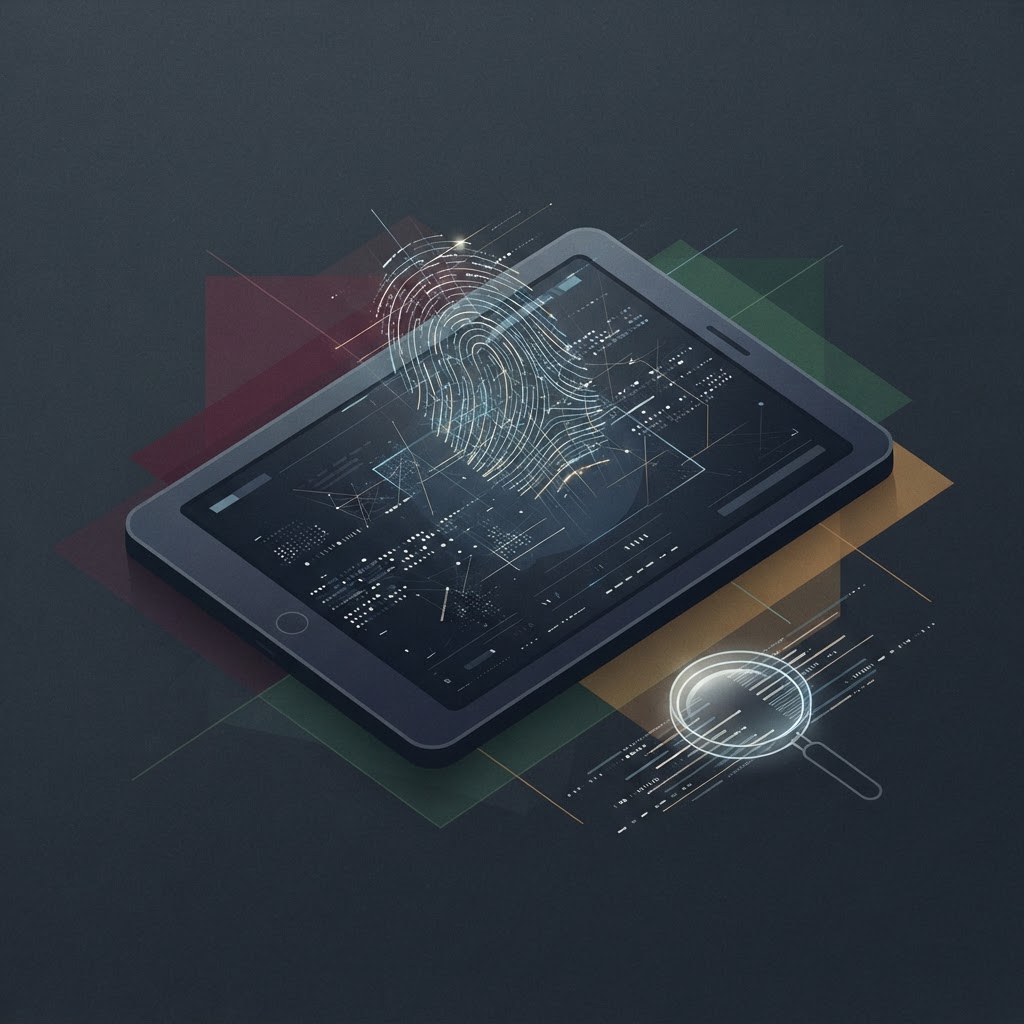
The Digital Exhaust: How Forensic Investigators Reconstruct Crime From the Traces Every Device Leaves Behind
In an era where a single floppy disk can unmask a serial killer and a laptop's RAM can expose a billion-dollar cybercrime network, digital forensics has become the most consequential — and most contested — discipline in modern criminal justice.
The Invisible Paper Trail
Every digital action leaves a mark. A file renamed, a message deleted, a USB drive inserted at 2:47 a.m. — each of these events writes itself into the architecture of a device in ways most users never perceive. This is the foundational premise of digital forensics, a discipline that has quietly evolved from recovering accidentally deleted documents to dismantling state-sponsored cyberattacks worth hundreds of millions of dollars.
The field borrows its intellectual backbone from one of criminology's oldest principles: Locard's Exchange Principle. Originally articulated by French forensic scientist Edmond Locard in the early 20th century, the principle holds that every contact leaves a trace. In physical forensics, that means fiber, hair, and fingerprints. In the digital world, it means registry keys, event log timestamps, metadata artifacts, and network packet headers. The medium has changed; the principle has not.
And the stakes have never been higher. The global digital forensics market is projected to reach approximately $15.5 billion by 2030, a figure driven by the exponential rise in cybercrime and the proliferation of IoT devices that generate evidence at every moment of their operation. Meanwhile, a 2023 IBM report placed the average cost of a data breach at $4.45 million — a number that makes rigorous forensic investigation not just a legal imperative, but a financial one.
From Floppy Disks to Fileless Malware: The Evolution of the Discipline
To understand how far digital forensics has come, consider the 2005 arrest of Dennis Rader, the BTK Killer, who had evaded law enforcement for three decades. His undoing was not a DNA sample or an eyewitness — it was a single floppy disk. Rader had sent a disk to police as part of his taunting correspondence, believing it was untraceable. Forensic analysts recovered deleted metadata embedded in a Microsoft Word document stored on the disk, which linked it to a computer registered to his church. A man who had successfully concealed himself for thirty years was undone by the invisible exhaust of a word processing application.
That case, now canonical in forensic literature, illustrates a truth that still holds: perpetrators are often defeated not by what they knowingly share, but by what their devices share without their knowledge.
Today, the technological terrain is vastly more complex. Smartphone forensics alone now accounts for over 70% of the workload in modern forensic laboratories. The reason is density: a single contemporary smartphone contains GPS movement history, encrypted messaging logs, biometric authentication records, Wi-Fi association data, and app-level behavioral patterns. It is, in effect, a continuous diary of its user's physical and digital life.
But perhaps the most technically demanding frontier in the field is memory forensics — the analysis of volatile RAM that exists only while a device is powered on. This discipline has become critical for detecting a particularly insidious category of threat: fileless malware. Unlike traditional malicious software that installs executable files onto a hard drive, fileless malware operates entirely within system memory, injecting code into legitimate processes and leaving no persistent footprint on storage media that standard disk imaging would reveal. By the time a device is powered down, the evidence is gone. Investigators must therefore capture and analyze live memory before shutdown — a time-sensitive, technically complex operation that has redefined acquisition protocols across the industry.
The Methodology: How Evidence Is Actually Collected
Acquisition and the Chain of Custody
Digital evidence is, by its nature, fragile and mutable. A single improper access to a storage device can alter timestamps and compromise the legal admissibility of every piece of data it contains. This is why forensic investigators rely on hardware write-blockers — physical devices that permit read-only access to storage media, ensuring that the examination process cannot modify the original evidence. Every step of acquisition is documented with cryptographic hash values (typically MD5 or SHA-256), creating a mathematical fingerprint of the original data that can later be verified in court.
This chain of custody is not procedural formality. It is the mechanism by which scientific findings are transformed into legally actionable evidence. Without it, even the most technically sophisticated analysis is inadmissible.
The Reconstruction Process
Once data is acquired, investigators work to reconstruct a timeline of events — a process that draws on dozens of artifact categories simultaneously. File system metadata reveals creation, modification, and access timestamps. Browser history and cache files expose online activity. Windows Registry hives log every application executed, every USB device inserted, every user account accessed. Network logs capture packet-level communications. Together, these sources allow analysts to construct a forensic narrative: not just what happened, but when, in what sequence, and often by whom.
The 2013 Silk Road investigation offers a landmark example of this reconstruction methodology in practice. When federal agents arrested Ross Ulbricht in a San Francisco public library, they seized his laptop while it was open and running — deliberately, to prevent encryption from locking the drive. The forensic imaging of that device revealed his personal journal, private chat logs with Silk Road administrators, and a live, authenticated connection to the 'Dread Pirate Roberts' admin account. The laptop was, in forensic terms, a fully unlocked confession.
Attribution at Scale: From Malware to Nation-States
Not all digital forensics is about individual perpetrators. Some of its most consequential applications involve attributing cyberattacks to organized groups or state actors — a process where the margin for error carries geopolitical consequences.
Following the 2014 Sony Pictures hack, forensic analysts from Mandiant conducted a detailed examination of the malware deployed in the attack. By reverse-engineering the malicious code and correlating command-and-control server IP addresses with previously catalogued infrastructure, they attributed the attack to the Lazarus Group, a threat actor associated with North Korean intelligence. The attribution relied not on a single data point, but on the convergence of multiple independent indicators — a methodology sometimes described as forensic triangulation.
A similar process unfolded during the investigation into the 2016 Democratic National Committee breach. Analysts identified artifacts from X-Agent malware — a tool with a documented history of use by Russian military intelligence — and cross-referenced metadata embedded in documents released under the 'Guccifer 2.0' identity. Cyrillic language settings and a username referencing Felix Edmundovich Dzerzhinsky, the founder of Soviet secret police, were among the artifacts that contributed to attribution. Individual metadata fields, invisible to ordinary users, carried the weight of an intelligence conclusion.
The Adversarial Dimension: Anti-Forensics
The discipline does not operate in a vacuum. Sophisticated actors are increasingly deploying anti-forensics techniques specifically designed to degrade investigators' ability to recover and interpret evidence. These include data wiping tools that overwrite storage sectors with random data, steganography — the concealment of information within innocuous files such as images or audio — and onion routing protocols that obscure network-level attribution by bouncing traffic through multiple encrypted nodes.
Encryption remains the most pervasive barrier. Approximately 80% of forensic investigators report that encryption is the primary technical obstacle they face in evidence recovery, requiring either advanced decryption tooling, exploitation of implementation vulnerabilities, or legal compulsion through court orders demanding passcodes or biometric unlocks. As end-to-end encryption becomes standard across consumer communication platforms, this challenge will intensify — and the legal frameworks governing compelled decryption remain unsettled in many jurisdictions.
The Road Ahead: AI, Volume, and Admissibility
The volume problem alone is staggering. A single corporate investigation may require the analysis of multiple terabytes of data across hundreds of devices, cloud accounts, and network logs. Human-only review is no longer feasible at this scale. The field is increasingly integrating artificial intelligence — specifically machine learning models trained to flag anomalous behavior, cluster related artifacts, and automate the triage of low-priority data — to concentrate investigator attention where it matters most.
Yet automation introduces its own evidentiary complexities. Courts are only beginning to grapple with questions of algorithmic transparency: if an AI system flags a file as suspicious, is its underlying logic sufficiently interpretable to withstand cross-examination? The technical and legal infrastructure for answering that question is still under construction.
What is not in question is the field's centrality to modern justice. Whether the case involves a serial killer's floppy disk, a darknet marketplace's open laptop, or a nation-state's malware fingerprints, digital forensics operates on the same immutable premise: the devices we use to navigate our lives record that navigation in extraordinary detail. For investigators, that detail is evidence. For the systems we trust, it is accountability. For the discipline itself, it is the entire foundation — one artifact, one timestamp, one hash value at a time.
Comments (0)
No comments yet. Be the first to share your thoughts.
Follow Us
© 2025 The Evidence Log. All rights reserved.
Sponsored by www.MilitaryDiscount.net
Website Designed By CharmCityInteractive.com