
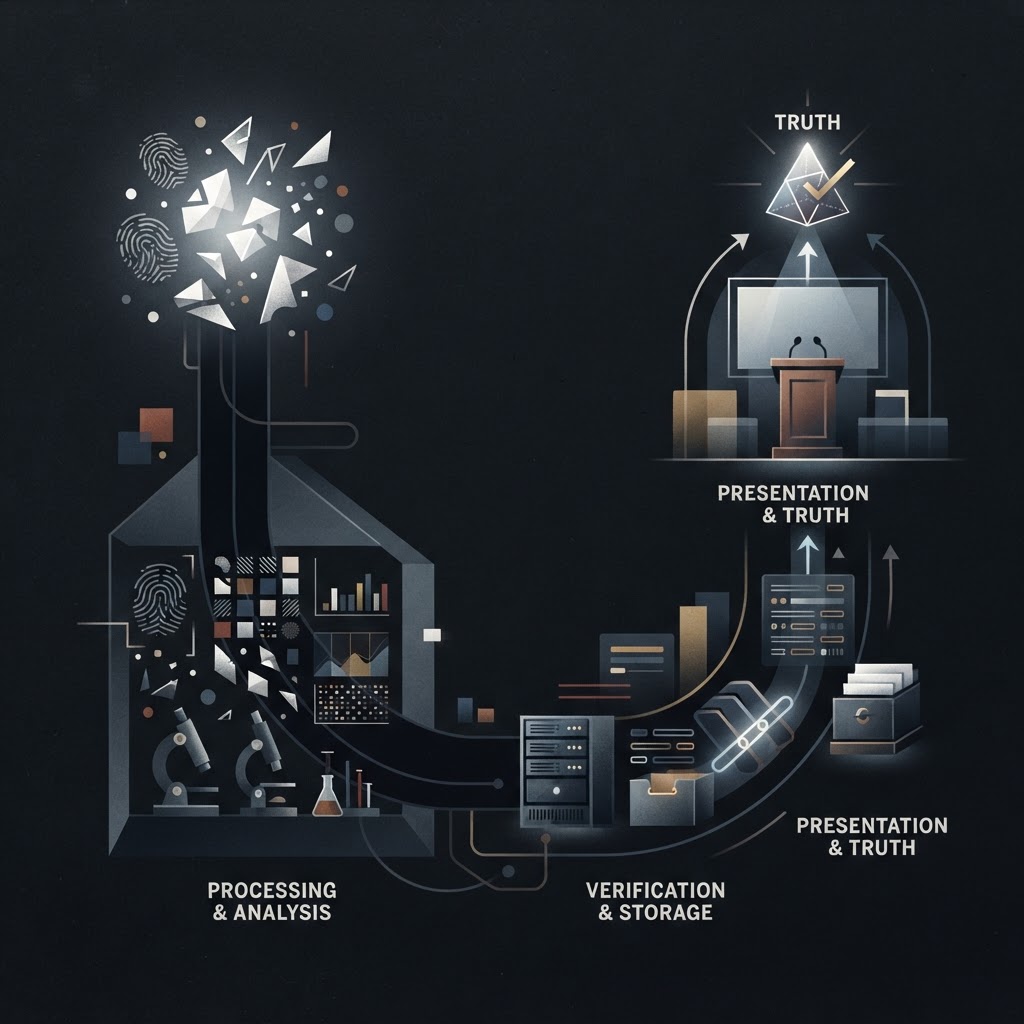
The Fragile Chain: How Evidence Lives, Degrades, and Dies Before It Ever Reaches a Courtroom
From the moment a piece of evidence is collected to the moment it is destroyed or archived, it passes through a gauntlet of human error, technological decay, and institutional failure. Understanding the lifecycle of evidence means confronting an uncomfortable truth: most cases are won or lost long before opening arguments.
The Lifecycle Nobody Talks About
In popular imagination, evidence is a static thing. A fingerprint lifted from a windowsill. A blood sample sealed in a vial. A text message screenshot submitted to a jury. We tend to treat these artifacts as inert facts — objective anchors in an otherwise murky sea of testimony and interpretation. But that framing is fundamentally wrong.
Evidence is not a noun. It is a process. From the moment a potential data point is identified at a scene or on a server, it enters a multi-stage lifecycle — Collection, Preservation, Analysis, Presentation, and Disposition — and at every single stage, it can be corrupted, degraded, lost, or rendered legally inert. The chain of custody is not bureaucratic paperwork. It is the circulatory system of the justice system. When it fails, the body dies.
What follows is an examination of where, how, and why that chain breaks — and what the evidence actually says about the scale of the problem.
Stage One: Collection and the Crisis of Authenticity
The collection phase is where evidence first acquires its legal identity. It is also where the modern investigator faces an entirely new category of risk that their predecessors never encountered.
Consider this single technical fact from the SANS Institute's forensic research: in a standard Windows operating system, a single file can carry over 20 different timestamps. A seemingly routine action — copying a file from one drive to another — can silently alter the 'Last Accessed' timestamp, permanently disrupting the original temporal record of that file. The evidence still exists. The data is still there. But its provenance, the verifiable story of when it was created and who touched it, has been compromised by a drag-and-drop.
This is the invisible mechanics problem. In the era of physical evidence, tampering required physical presence and deliberate action. You had to move the knife, swap the vial, forge the signature. In the digital realm, evidence can be altered by accident, by software, by a routine system update running in the background while a drive sits in a lab queue.
And those queues are growing. According to the International Association of Computer Investigative Specialists, over 90% of modern criminal investigations now involve a digital component. Yet forensic backlogs for mobile devices alone average between 3 and 12 months in mid-sized jurisdictions. The collection phase increasingly ends not with secured evidence, but with a device sitting in a property room, its internal clock ticking, its file system quietly rewriting itself.
Stage Two: Preservation and the Physics of Decay
Assume collection goes perfectly. The device is imaged correctly, hashes are verified, metadata is intact. The evidence now enters the preservation phase — and here, a second category of failure awaits: the physics of storage itself.
The Digital Preservation Coalition has documented a phenomenon known as 'bit rot,' the gradual, spontaneous degradation of data stored on magnetic media. Standard hard drives begin to face significant risk of bit rot after just three to five years if the data is not actively managed or migrated to new storage. This is not a fringe technical concern. It is a fundamental material property of the medium on which most digital evidence is stored.
The implications for cold cases are severe. A homicide from 2019 with digital evidence stored on a standard drive and left unmanaged could, by 2024, be facing silent, undetectable data loss. The evidence log might show the file is present. The file size might appear unchanged. But the underlying binary data may have shifted — enough to corrupt a video, scramble a document, or, critically, invalidate the cryptographic hash that verified its integrity in the first place.
The cost of solving this problem is real and measurable. Fortune 1000 companies, operating under civil litigation and regulatory compliance pressures, spend an average of $15 million annually on e-discovery and digital evidence management, with the majority of costs concentrated in the collection and review stages, according to research from the RAND Corporation's Institute for Civil Justice. Law enforcement agencies, operating on municipal budgets, face the same technical requirements with a fraction of the resources.
Stage Three: Processing and the Human Variable
The processing and analysis phase is where the lifecycle intersects most directly with human judgment — and where the consequences of failure are most historically documented.
The case of Annie Dookhan and the Hinton State Laboratory in Massachusetts offers one of the starkest examples on record. Dookhan, a state chemist, engaged in what the field calls 'dry-labbing': identifying drug samples by sight rather than subjecting them to chemical analysis, then falsifying results and forging colleague signatures to certify tests that were never conducted. The processing stage of the evidence lifecycle was not merely flawed — it was fabricated. The downstream result was catastrophic: over 21,000 drug convictions were dismissed because the analytical foundation of those cases had been irredeemably compromised. Evidence that had survived collection and preservation was destroyed entirely in the processing phase by a single actor operating without adequate oversight.
This is not an isolated pathology. Data from the National Registry of Exonerations, drawn from a review of 1,300 exoneration cases, found that unreliable or improper forensic science contributed to 24% of wrongful convictions. Nearly one in four. The evidence existed. It was collected, preserved, and processed. But its interpretation — the translation from raw artifact to legal fact — introduced sufficient error to convict the wrong person.
The processing phase is where the lifecycle's dependence on institutional integrity becomes impossible to ignore.
Stage Four: The Administrative Lifecycle and the Problem of the Backlog
Parallel to the digital evidence crisis sits a physical evidence failure of staggering proportions. As of 2022, the United States maintained an estimated backlog of over 200,000 untested sexual assault kits, according to data compiled by the End the Backlog initiative at the Joyful Heart Foundation. These kits — each representing a survivor, a crime scene, a documented collection effort — exist in a suspended state. They have been collected. They have not been processed. They occupy a liminal zone in the evidence lifecycle where the potential for justice is preserved but unrealized, and where the passage of time steadily erodes that potential through statute of limitations clocks, degrading biological material, and fading witness memory.
This is the administrative lifecycle failure: not tampering, not technical decay, but institutional inaction functioning as a form of evidence disposal.
Stage Five: Disposition and the Legal Weight of Destruction
The final stage of the evidence lifecycle — disposition — is perhaps the least examined and the most legally consequential. Evidence does not simply cease to exist. It is destroyed, archived, returned, or expunged through deliberate institutional process. And the manner of that disposition carries full legal weight.
The Enron investigation established this principle in the civil and criminal context with unusual clarity. When Arthur Andersen LLP auditors destroyed tons of Enron-related documents as the SEC investigation was announced in 2001, they were not merely cleaning files. They were engaging in the intentional end-of-life management of evidence — and that act of disposition was itself prosecuted. The destruction of evidence in anticipation of legal proceedings is obstruction. It established that the termination of an evidence lifecycle is as legally significant as its initiation.
A parallel, if more systemic, example emerges from the Hillsborough disaster investigation. Following the 1989 stadium crush that killed 97 people, it was revealed decades later that 164 police statements had been significantly amended to remove criticisms of police conduct. The alteration was not destruction — the statements still existed — but the manipulation of the administrative record during the lifecycle's documentation phase effectively rewrote the evidentiary history of the event for over two decades.
The Future: Verifying the Journey, Not the Artifact
The trajectory of these failures points toward a single emerging principle in forensic science and evidence law: the future of evidence integrity lies not in the artifact itself, but in the immutable, verifiable log of its journey.
As AI-generated content and deepfake technology mature, the collection phase faces a crisis of authenticity that no amount of metadata analysis will fully resolve at the artifact level. A fabricated video can now carry plausible timestamps, realistic compression artifacts, and synthetic camera noise. Verifying the evidence itself becomes insufficient. What investigators will increasingly need to verify is the hardware, the network environment, and the cryptographic chain of custody from point of origin — a shift from forensics of content to forensics of provenance.
The evidence lifecycle is not a straight line. It is a chain of contingencies, each link dependent on the strength of institutional protocols, technical infrastructure, and individual integrity. The data makes clear that the chain breaks regularly, predictably, and at every stage. Understanding where it breaks is the prerequisite for building something that holds.
Comments (0)
No comments yet. Be the first to share your thoughts.
Follow Us
© 2025 The Evidence Log. All rights reserved.
Sponsored by www.MilitaryDiscount.net
Website Designed By CharmCityInteractive.com