
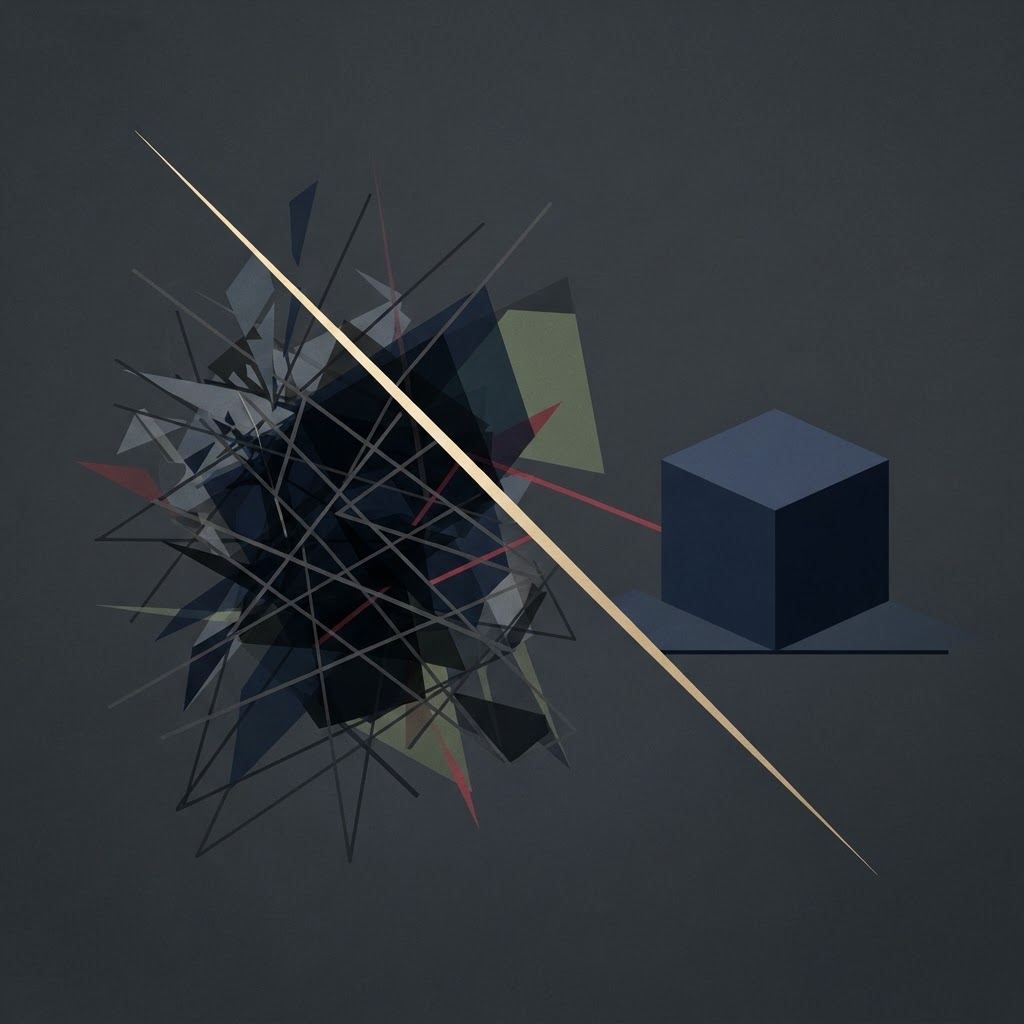
The Parsimony Paradox: How Occam's Razor Cuts Through Noise — and Sometimes Cuts Too Deep
From Bayesian statistics to evolutionary biology and neural network design, Occam's Razor has been mathematically formalized as one of science's most powerful heuristics — but the same blade that sharpens our thinking has historically drawn the wrong conclusions when simplicity outpaced evidence.
The Parsimony Paradox: How Occam's Razor Cuts Through Noise — and Sometimes Cuts Too Deep
In the 14th century, a Franciscan friar named William of Ockham articulated a deceptively simple principle: plurality should not be posited without necessity. Seven hundred years later, that same principle is embedded in Bayesian probability theory, machine learning regularization algorithms, and the clinical decision-making frameworks used in hospital wards around the world. Occam's Razor is no longer just a philosophical heuristic — it is a mathematically formalized, empirically tested, and occasionally dangerous tool. Understanding how it actually works, and when it fails, tells us something profound about how both human minds and artificial systems navigate uncertainty.
What the Razor Actually Does
Occam's Razor is frequently misquoted as "the simplest explanation is usually correct." That is not quite right. The more precise formulation is an abductive one: among competing hypotheses with equal explanatory power, prefer the one that requires the fewest assumptions. The distinction matters enormously. The razor does not adjudicate between explanations of different quality — it is a tiebreaker, not a truth-finder.
In modern statistics, this tiebreaking function has been given a precise mathematical identity. The Occam Factor is defined as the ratio of the posterior parameter volume to the prior parameter volume in a Bayesian model. In plain language, it measures how much a model's parameter space must "shrink" to fit the observed data. A complex model with many free parameters covers a vast prior volume, and when it successfully fits the data, that fit occupies only a tiny slice of all the things it could have predicted. The Occam Factor penalizes this extravagance. A simpler model that makes fewer predictions is rewarded precisely because its successful predictions were less likely to be accidental. This penalty is automatic and mathematically rigorous — not a stylistic preference.
The implication is significant: Bayesian model comparison does not simply reward goodness-of-fit. It builds parsimony directly into the probability calculus.
Kolmogorov Complexity and the Machine Learning Connection
The razor's mathematical life extends into computer science through the concept of Kolmogorov complexity (KC) — a measure of the shortest possible description length of a function or dataset. A function with low KC can be described concisely; one with high KC requires a long, idiosyncratic specification. Empirical studies in machine learning have demonstrated that models with lower KC tend to generalize better to unseen data. This is not coincidental: high KC models are, by definition, fitting the specific noise of their training data rather than the underlying signal.
Researchers working on neural network regularization have operationalized this insight through Kolmogorov Growth constraints, which keep model parameter trajectories within low-complexity zones during training. By enforcing a kind of computational parsimony, these techniques actively prevent overfitting — the machine learning equivalent of building a conspiracy theory that explains every anomaly by adding a new actor to the plot. The more elaborate your model becomes, the more it begins to describe the noise rather than the story.
This is Occam's Razor running as code.
The Human Brain as a Parsimony Engine
Perhaps the most striking finding in recent Occam's Razor research is that human cognition appears to implement a version of the razor automatically — and not always consciously.
A study in perceptual estimation found that when participants made judgments in high-variance conditions, their mean estimates (59.75) were significantly lower than in low-variance conditions (mean 61.82). The interpretation is counterintuitive at first: under noisy, uncertain conditions, participants did not simply average their observations. Instead, they appeared to apply a simplicity bias, pulling their estimates toward lower, less complex values. The brain, in other words, was applying a parsimony correction to compensate for environmental noise — essentially implementing a statistical prior that disfavors complexity when the signal-to-noise ratio is poor.
Separate research on human decision-making has shown that people integrate over latent causes when evaluating outcomes, effectively performing a kind of informal Bayesian model averaging. Rather than locking onto the single most likely cause of an event, people weight multiple potential causes by their plausibility — and this integration process functions as a natural filter against overfitting to noisy observations. We are, at a deep cognitive level, built to seek parsimony.
Applied Parsimony: Where the Razor Works
Phylogenetics
In evolutionary biology, the method of maximum parsimony applies the razor to the construction of phylogenetic trees — diagrams showing the evolutionary relationships between species. The principle is straightforward: among all possible evolutionary trees connecting a set of organisms, select the one that requires the fewest total mutations. This minimizes the number of independent evolutionary events that must be assumed, producing the most efficient explanation of observed genetic differences. While parsimony is not the only phylogenetic method available, and has been supplemented by maximum likelihood and Bayesian approaches, it remains foundational to the field's logical architecture.
Medical Diagnostics
In clinical medicine, the razor appears as a guiding heuristic: when a patient presents with multiple symptoms, the preferred initial hypothesis is a single underlying cause rather than several independent diseases converging simultaneously. This principle, sometimes called diagnostic parsimony, reduces unnecessary testing and treatment while focusing clinical attention on systemic explanations. A patient presenting with fatigue, weight loss, and night sweats is more likely suffering from one condition — lymphoma, tuberculosis, or HIV — than three separate ailments that happen to share a waiting room. The razor does not guarantee this, but it provides a rational starting point.
Planetary Models
The historical shift from the Ptolemaic model of the solar system to Keplerian ellipses is one of the clearest demonstrations of the razor's explanatory power. Ptolemaic astronomy required an elaborate architecture of epicycles — circles within circles — to account for the observed motion of planets. Kepler's ellipses replaced this machinery with a single geometric shape. The Keplerian model was not adopted because it was simpler in a naïve sense — ellipses were mathematically unfamiliar to many at the time — but because it achieved equal or greater predictive accuracy with dramatically fewer structural assumptions. The razor, properly applied, is about assumption economy, not surface-level simplicity.
When the Razor Cuts Wrong
The history of science contains cautionary episodes in which parsimony became an obstacle to discovery. Continental drift is the most instructive example. When Alfred Wegener proposed in the early 20th century that the continents had once been joined and had since drifted apart, the geological establishment largely rejected the idea — not because the evidence was absent, but because no known mechanism could explain how continents might move through oceanic crust. The simpler explanation, that the continents were stationary and the fossil similarities across oceans were coincidental or explained by land bridges, was preferred. Wegener's theory was complex and speculative. It was also correct.
Similarly, early debates about the structure of DNA saw simpler molecular models preferred over more elaborate ones, delaying recognition of the double helix. In both cases, the razor cut against the grain of emerging evidence because the evidence was incomplete. Simplicity was used not as a tiebreaker between equally supported hypotheses, but as a substitute for evidence itself.
This is the razor's fundamental failure mode: it is a tool for choosing between hypotheses, not for dismissing hypotheses that lack full evidential support. When applied prematurely — before the evidence base is mature — it can systematically exclude correct but complex explanations.
The Calibration Problem
The deeper issue is one of calibration. Occam's Razor is a prior, not a posterior. It tells us where to start looking, not where to stop. The mathematical formalizations — Occam Factor, Kolmogorov complexity, Bayesian model selection — all share this property: they weight parsimony against evidence, not instead of it. As evidence accumulates for a complex theory, the penalty for complexity can and should be overridden by likelihood gains.
The practical lesson for any investigator — whether a forensic scientist, a clinician, a data analyst, or an evolutionary biologist — is the same: begin with parsimony, but hold it lightly. The razor should narrow the field of hypotheses, focus investigative resources, and guard against the cognitive trap of proliferating explanations for noisy data. It should not become a ceiling that prevents the ascent to more complete, if more complicated, truths.
Seven centuries after William of Ockham sharpened his argument, his razor remains one of the most useful instruments in the analytical toolkit. The evidence suggests it is wired into our cognition, formalized in our algorithms, and embedded in our best scientific methods. The evidence also suggests it has been wrong before — and will be wrong again, wherever simplicity is confused with truth.
Comments (0)
No comments yet. Be the first to share your thoughts.
Follow Us
© 2025 The Evidence Log. All rights reserved.
Sponsored by www.MilitaryDiscount.net
Website Designed By CharmCityInteractive.com