
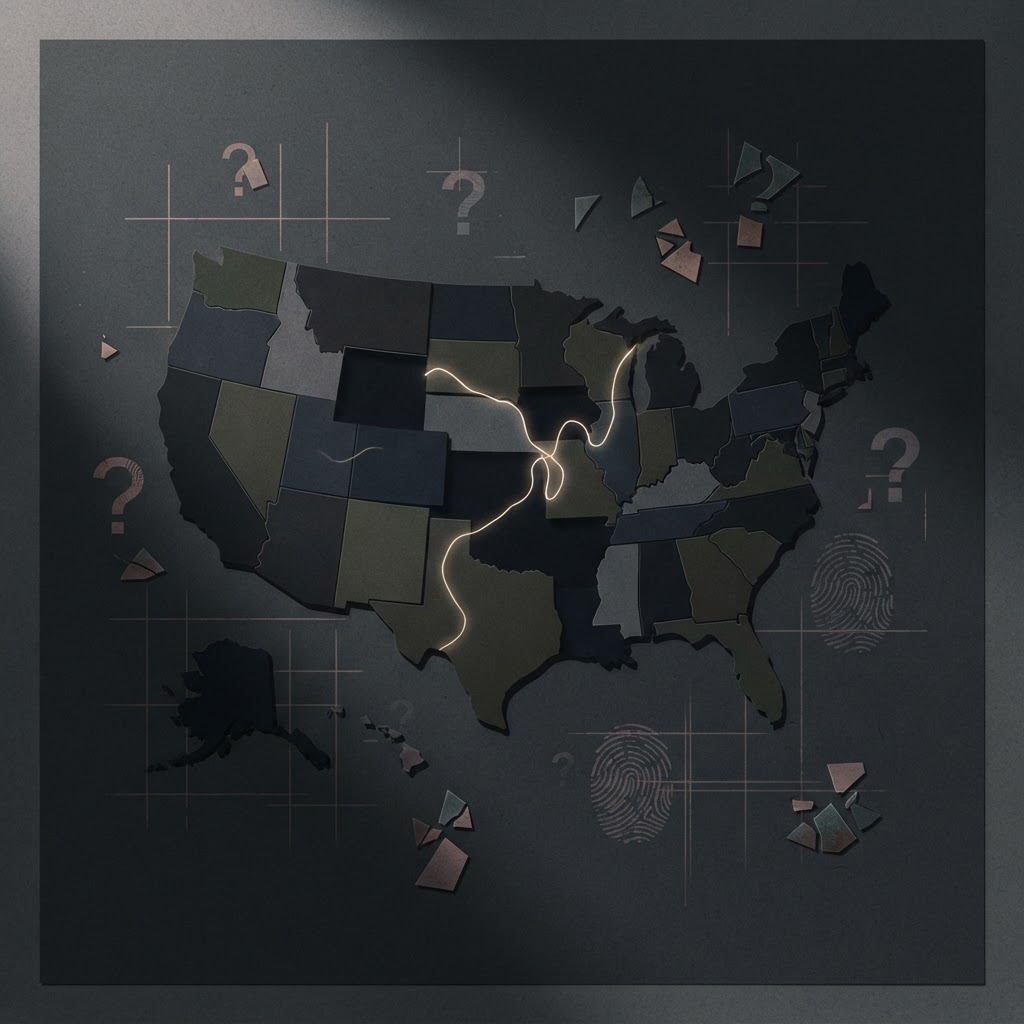
The Anatomy of the Unanswered: What Data Reveals About Why Cases Go Cold
With roughly 331,000 homicides unsolved in the U.S. since 1965, the persistence of cold cases is not simply a matter of missing clues — it is a measurable product of systemic failure, cognitive bias, and the fundamental architecture of human memory.
The Anatomy of the Unanswered: What Data Reveals About Why Cases Go Cold
There is a particular kind of discomfort that settles in when a story has no ending. It is not passive. It nags, resurfaces, and refuses to be filed away. For investigators, families, and even the general public, unsolved cases occupy a permanent cognitive foreground — and the science behind that experience is as revealing as the casework itself.
But before we examine the psychology, we must first confront the scale of the problem. Approximately 34% of homicides reported in the United States between 1965 and 2020 remain unsolved, totaling an estimated 331,000 cases. That is not a rounding error or a statistical anomaly. It is a systemic reality — one shaped by institutional limitations, investigative failures, and the gradual erosion of evidence over time.
Understanding why cases go cold requires looking beyond the absence of a suspect. It requires examining the machinery that processes, preserves, and pursues evidence — and the points at which that machinery consistently breaks down.
The Information Gap and Why We Cannot Look Away
Before addressing the mechanics of cold cases, it is worth establishing why they hold such durable cultural and psychological power. In 1994, behavioral economist George Loewenstein proposed what he called the information gap theory — the idea that curiosity arises not from the desire to learn in the abstract, but from the acute awareness of a specific gap between what we know and what we want to know. That gap functions as a form of cognitive deprivation. It is uncomfortable, and we are compelled to close it.
This is why the Zodiac Killer — a still-unidentified murderer who taunted Bay Area press with encrypted messages throughout the late 1960s and early 1970s — remains one of the most obsessively studied criminal cases in American history. The information gap is enormous and deliberately constructed. The killer provided just enough to suggest the answer was findable, while ensuring it remained elusive. Decades later, amateur cryptographers, documentary filmmakers, and investigative journalists are still attempting to close that gap.
The psychological mechanism reinforcing this drive has a name: the Zeigarnik Effect, first documented by Soviet psychologist Bluma Zeigarnik in the 1920s. Her research demonstrated that humans remember incomplete tasks significantly better than completed ones. Applied to unsolved cases, this means that unresolved narratives do not fade — they persist and demand cognitive attention. The brain treats an open case like an open tab: it keeps running in the background, consuming resources, waiting for resolution.
For families of victims, this effect is not merely academic. It is a lived experience of suspended grief, where closure is structurally unavailable.
Where Investigations Break Down: The Human Variables
Forensic science tends to receive the most public attention in cold case discussions — and for good reason. The Black Dahlia murder of 1947 remains unsolved in part because the original crime scene yielded minimal recoverable evidence, and the forensic tools available at the time were incapable of bridging that evidentiary gap. No amount of retrospective analysis has been able to compensate for what was not collected or preserved in the first 72 hours.
But physical evidence is only part of the equation. Cold cases are frequently stalled by a less visible category of failure: human factors.
Detective Workload and Tunnel Vision
Investigators operating under high caseloads face a well-documented phenomenon known as tunnel vision — a cognitive narrowing in which early assumptions about a suspect or motive become self-reinforcing. Evidence that contradicts the working theory is unconsciously minimized; evidence that supports it receives disproportionate weight. This is not unique to law enforcement. It is a feature of human cognition under pressure and uncertainty.
When combined with high turnover among investigative personnel, tunnel vision becomes compounded. New detectives inheriting a cold case often inherit its assumptions as well — the documented narrative of the original investigation shapes what they look for and what they overlook. The systemic bias is baked into the file before the new investigator opens it.
The Reliability Problem in Witness Memory
Memory is not a recording. It is a reconstruction — and reconstructions are vulnerable to interference. In cold cases, where witnesses may be asked to recall events years or even decades after the fact, this vulnerability is significantly amplified.
Research consistently shows that memory recall is highly susceptible to contamination, particularly under conditions of emotional stress. Witnesses who were present at or near a traumatic event encode their memories in a neurologically altered state, which affects both the accuracy and the stability of those memories over time. Subsequent exposure to media coverage, conversations with other witnesses, or even the phrasing of interview questions can silently alter what a witness believes they remember.
In high-profile cases, this contamination is nearly impossible to prevent. By the time a cold case is reinvestigated, the evidentiary value of eyewitness testimony has often degraded beyond reliable use.
The Stranger Variable: Why Randomness Defeats Investigation
One of the starkest statistical patterns in unsolved homicides is the relationship between victim-offender familiarity and case resolution. Cases involving strangers and surprise attacks are statistically more likely to remain unsolved than those involving known associates. This is structurally logical: investigations typically begin by mapping relationships. When no prior relationship exists, that map starts blank.
The investigative model that dominates most homicide units — interview the inner circle, establish motive, trace opportunity — is built on the assumption of connection. Random or opportunistic violence breaks that model entirely, leaving investigators without the relational scaffolding on which most cases are built.
This is also why public tip systems and media exposure have historically played a more significant role in stranger cases than in domestic or associate-related homicides. The 1987 case of Rose Marie, who was reunited with her biological parents after a viewer recognized her as a co-worker following an episode of Unsolved Mysteries, illustrates the latent investigative power of public exposure. The information that resolved her case existed in the public — it simply lacked a delivery mechanism until television provided one.
The Long Arc of Physical Evidence
Beyond human memory, the physical substrate of a case is subject to its own form of entropy. Biological evidence degrades. Chain-of-custody documentation goes missing. Storage facilities are cleared. The longer a case remains open, the narrower the window of forensic opportunity becomes.
This does not mean technology cannot close old gaps — DNA analysis has reopened cases that appeared permanently sealed. But technology can only work with what survives. The Voynich Manuscript, a 15th-century document containing nearly 38,000 words in an undeciphered script, offers an instructive parallel from outside criminal investigation: even the most sophisticated modern analytical tools have failed to decode it, not because the methodology is inadequate, but because the underlying data — the key to the system — may simply no longer exist. Some information gaps, once opened, cannot be closed.
What the Data Tells Us
The 331,000 unsolved homicides in the United States are not simply a backlog. They are a structured outcome — the product of measurable variables including investigative bias, evidentiary decay, relational distance between victim and offender, and the compounding effect of time on both memory and material. Each of these variables is documented, quantifiable, and in some cases, addressable through systemic reform.
The psychological pull of unsolved mysteries is real and rooted in cognitive architecture. But the evidence behind the scenes tells a more grounded story: most cases go cold not because the truth is unknowable, but because the systems designed to find it were under-resourced, biased, or simply ran out of time.
The information gap remains open. The machinery that might close it is the more pressing subject of investigation.
Comments (0)
No comments yet. Be the first to share your thoughts.
Follow Us
© 2025 The Evidence Log. All rights reserved.
Sponsored by www.MilitaryDiscount.net
Website Designed By CharmCityInteractive.com